Showing posts with label Dracula. Show all posts

Monday, 5 June 2017

Vampira

"Vampira" (aka "Old Dracula", 1974, Clive Donner, Columbia-Warner, American International Pictures) is a horror comedy about everyone's favourite vampire Count.

Count Dracula (David Niven) is getting old. In order to survive, he has began hosting tours of his castle where he can feast on curious tourists. When a group of beautiful, young Playboy girls stay at the castle, Dracula sees an opportunity to attempt to revive his lover, Vampira. One of the Playmates was a black lady (Minah Bird) and so, naturally, the Countess comes back as the beautiful Teresa Graves. While the Count hunts down more blood for the Countess with the help of a photographer called Marc (Nicky Henson), the Countess goes out on the town, enjoying the sights and sounds of the 70s.

A rather silly flick in both plot and acting. It's certainly not one of David Niven's best films by a long shot, but he brings the Count to life in his usual gleeful, gentlemanly style. Teresa Graves plays the proper Countess letting loose with her new persona and her new modern time in a fun and flamboyant way.

The premise is a little controversial, and the film is full of awkward comments, but on the whole the film is pretty innocent and mildly entertaining. From the comedy vampire bites to the vampire disco it's very of-its-time.

[Image: Columbia-Warner, et al]
Hani

Monday, 13 February 2017

The Brides of Dracula

"The Brides of Dracula" (1960, Terence Fisher, Hammer Film Productions, Universal-International) is a Hammer Horror sequel to "Dracula" (1958) although it does not feature the prince of darkness himself.

Marianne (Yvonne Monlaur) is a young, French teacher on her way through the Transylvanian countryside to take up a job. She is abandoned by her coach driver and is invited to take refuge for the night at a large, impressive castle by an elderly noblewoman called Baroness Meinster (Martita Hunt). Of course, the Baroness has devious plans for young Marianne...

At the castle Marianne happens across the Baroness' handsome son, the Baron (David Peel), whom she sees is chained up. The Baroness and her servant, Greta (Freda Jackson), inform her to take no heed of the young Baron; he is insane. Having taken pity on the Baron, however, Marianne frees him of his shackles before fleeing. Dr. Van Helsing (Peter Cushing) arrives, having been called due to the suspicious death of a young lady on the first night of the Baron's freedom. But can he stop the villainous vampire before he claims every fair maiden in the village in his quest to create an army of sultry, vampire vixens!

A very typical Hammer Horror production with wonderful sets, some cheesiness and beautiful 60s colour cinematography. While we lack Christopher Lee's ominous presence as Dracula, Peter Cushing brings a touch of class to the production with his effortless style and presence. The vampires enjoy some extra skills that Dracula himself did not get to enjoy and we get to see some lady vampires rise from their graves.

[Image: Hammer Film Productions]
 
Hani

Monday, 10 November 2014

Dracula Untold

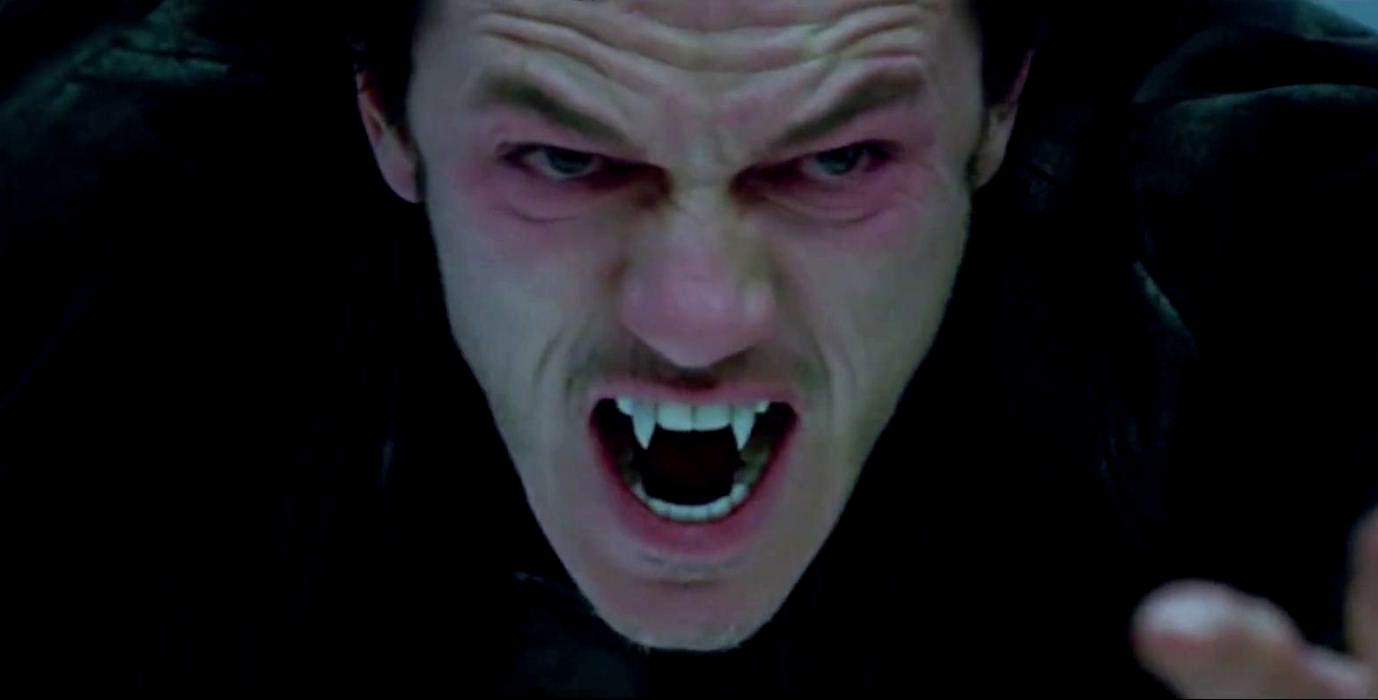
"Dracula Untold" (2014, Gary Shores, Universal Pictures, Legendary Pictures) depicts the origin tale of Dracula.

Vlad Tepes, the Impaler, Prince of Transylvania (Luke Evans) seeks some unorthodox help to defeat his Turkish ex-captors and maintain the freedom of his homeland and its people. Much to his detriment, as we all know.

I wouldn't call this a fantastic vampire film, but I equally won't bestow on it the bile that many online bloggers have. Yes, the film is not Bram Stoker's Dracula, but it never claims to be. Yes, there are historical inaccuracies, but it's not a documentary. In fact, I found it to be a refreshing take on a classic tale, even if it does often delve into the more comic book action genre than anything resembling horror.

It's not a serious film, nor an accurate historical character study, nor even a horror movie. But it does well to capture the era, the desperation and shows a more human side to the famous character than previously investigated in the rather bloated world of vampire cinema.

Evans creates an attractive Vlad, but Charles Dance steals the show however, with his fabulous talent for creepiness with a touch of bitter disappointment and that fanged grin.

Image: Universal Pictures
 
Hani

Tuesday, 7 August 2012

Vampire In Brooklyn

"Vampire in Brooklyn" (1995, Wes Craven, Paramount Pictures) is a horror comedy taking some elements of Dracula and general vampire lore and applying them in modern day New York with Eddie Murphy as the vampire. It's also so 90s you could die!

The plot takes the generic Dracula story and alters it to suit its ends. Craven's good at this, and the plot flows quite well. It's main fault being, however, that this genre is overflowing and it's been done better before and since.

Maximillian (Eddie Murphy) is a master vampire who lands by boat (full of snacks and by snacks I of course mean, crew members) in New York. Murphy plays the part well, showing that although he's become more well-known as voicing smart-ass (see what I did there?) donkeys and OTT family movies with a one-man cast, he actually is two things 1) funny 2) a good character actor. He also looks good in the part.

Being an Eddie Murphy movie, he of course has to play several different characters in increasingly silly costume. However, at least in this movie, he is a master vampire, transforming into different people to confront the female character. So there's a bit more of a reason for him to keep doing this!

Maximillian is a vampire from the Caribbean. He has been living in the Bermuda Triangle, Craven's explanation for the missing people in this infamous spot being that vampires are eating them. He has come to realise that he will perish before the end of the next full moon, and has come to NY to find a specific woman; a half-vampire daughter of a Caribbean vampire. Unfortunately, said woman is a NYPD cop called Rita (Angela Bassett. Who was also in "Critters 4" might I add!). Rita doesn't know her origins and her mother, who was mentally ill (probably caused by vampire mind tricks. I'm just saying!), has recently died, affecting Rita greatly. Rita also gets visions and paints them. So, just your typical troubled horror maiden, really.

Max finds himself a 'ghoul' (a Renfield character) to be his man-servant. The ghoul selected is a down-on-his-luck NY man called Julius (Kadeem Hardison), who's in trouble with some of the local Mafia. Julius acts as comedic foil to Murphy's straight man. Julius' uncle Silas (John Witherspoon) is also a funny character, bouncing off of the Julius character as a bit of a double act. He's all too aware that his nephew is in league with the undead (apparent as he is not surprised or overly concerned when Julius begins to decay at a rapid rate, despite still being 'alive'!).

With some vampire trickery, aforementioned transformations and other comedy-horror plot turns, Max attempts to woo Rita. Despite the chemistry between Rita and her work partner Justice (Allen Payne).

Traditional vampire lore applies:
  • Wolf transformations
  • Blood drinking
  • No reflections
  • Renfield-esque assistant
  • A Mina character
  • A dislike of garlic
  • Mind tricks
  • yadda yadda
The film is updated with setting, behaviour, music, humour etc... but by today's standards is dated by it being oh so 90s.

Not a horror in the true sense of the word, but a nice family film from the great Wes Craven. And a typical family-comedy movie happy ending for at least 2 of the characters.

Special effects are typical 90s, and my main annoyance was being able to see where Eddie Murphy's wig was glued to his scalp!

90s comedy horror. What more can I say?

[Picture: Paramount Pictures]

Hani


Tuesday, 31 July 2012

Nosferatu (1922)

"Nosferatu" (1922, F.W. Murnau, Prana Film) is a German Expressionist silent horror movie based on Bram Stoker's "Dracula". Although, because it was not an authorised adaptation, in order to avoid copyright infringement, they changed the names of the characters and some small pieces of the plot. Not that this helped them at all, when the Stoker family took them to court...

Count Orlok (Max Schreck) is a vampire count living in Transylvania in the Carpathians. Sound familiar?

He is interested in purchasing a house in Wisborg, Germany (hint, not a real city) and contacts a company in Wisborg owned by a character called Knock (Renfield by any other name. Played by Alexander Granach). Knock sends young Hutter (The Harker character. Played by Gustav von Wangenheim) to the Carpathian region to meet with the count and deal business.

Hutter sets off immediately, much to the upset of his wife, Ellen (Mina. Played by Greta Schröder).

The film follows the general Dracula tale with Hutter travelling to the region, the locals being wary of the name of the count, getting to the castle by carriage and then by foot as the driver will go not closer, wolves, Orlok being creepy, a small cut and an overreaction to the "Precious blood" from the Count... yadda, yadda.

We also see Orlok travel by boat to Wisborg, killing the crew as he does in most versions of the famous tale, travelling in coffins filled with earth... and so on.

Orlok takes Ellen under his spell, distills fears in the townsfolk of plague, and drives Knock insane by turning him into a human-vampire-bug-eating-underling (not Human Servant if you read laurell K. Hamilton, you'll know that's entirely different).

The film is very old, and can be seen for free on YouTube as a slightly remastered copy with some subtitles for the ye olde script, where needed. Although all the dialogue cards are in English (but sometimes difficult to read, 'Hutter' looks like 'Butter' which just made us think of "South Park"!)

I do love this jumpy old fashioned film. Watch for things and people just popping out of sight or appearing from nowhere!

The real beauty of this film is not the acting or the plot, it's the fact it's a silent film with a traditional piano track. The makeup for the time is also excellent and the iconic image of the Nosferatu looming over the sleeping Ellen is one of the best known in cinema.

A real history lesson for any horror fan!

Some of the special effects must have dazzled the viewers in 1922; stop motion, Orlok rising into an upstanding position from a prone position, doors closing themselves, coffin lids rising... etc...

It is evident through most of the scenes that they have been shot in daylight, despite there being a vampire present... as the film equipment of the time would not have captured such scenes in a dark setting. And I'm afraid ol' Orlok has a reflection.

The overacting used in this period of film to convey the emotions and plot are hilarious for modern viewers! But were quite standard for the time, so don't go thinking this film is, in any way, bad. And Hutter's grinning, expressive face is just a hoot!

Ellen's 'I'm-sad-so-sad' look makes her look almost zombie-like and that's before she's even under the Nosferatu's spell!

Some of the scenes are just completely random, and the plot can be a bit jumpy. But on the whole, it's very well captured and the quality of the YouTube video is actually pretty damn good! Especially considering that it is not made from the original (and only, negative) but several later copies strung together! The original film may have been destroyed when they lost the rights to Stoker, I can't remember.

The demonic horses were my favourite part; real horse and cart sped up to look 'inhumanly fast' and the horses were wearing masks to make their faces look more like dragons!

Also, watch for the shipmate who looks a bit like Harry from "Dumb and Dumber"! And the weird stripey 'werewolf' in the woods!

This is a film strictly for real horror-history-geeks or people studying cinematography as an academic interest. It's not a fast or scary film and the Nosferatu's creepy, sinister movements are just laughable to the modern viewer who are more used to masked slashers and super-fast vampires in leather. Although, if you sit in a nice dark room with some candles burning, maybe there's a thunderstorm outside, this film can be enjoyed to its full extent.

Really good fun, and it lets you appreciate how horror cinema has developed.


[Picture: Arts Guild]

Hani


Sunday, 24 June 2012

Bram Stoker's Dracula

"Bram Stoker's Dracula" (1992, Francis Ford Coppola, American Zoetrope, Columbia Pictures) is the big-budget version of Dracula.

It stars Gary Oldman in the title role, who plays a Dracula who is surprisingly close to the novel. Not that I don't love Bela Lugosi, Christopher Lee or Richard Roxburgh's versions of the famous Vampyr.

The film does well to stick to Stoker's plot and the styling of the film scenes and storytelling are beautifully reminiscent of the classic Dracula films.

The special effects are artful, and although slightly dated by today's standards, very effective and eerie. I'm a big fan of the way they captured Dracula's shadow which moves on its own accord.

The plot, in case you've been under a particularly secluded rock, is thus:

Vlad Dracula returns from the holy wars to find that his love, Elisabeta (Winona Ryder) has committed suicide, believing him killed in battle. Dracula is informed by his holy men that as Elisabeta died at her own hand, God will not allow her soul to enter heaven. Enraged, Dracula renounces God and declares that he will fight on the side of darkness, returning after his death, to avenge Elisabeta.

Jonathan Harker (Keanu Reeves), a young solicitor trying to make his mark on the world so that he can marry his lady love, Wilhelmina "Mina" Murray (also Winona Ryder), is sent on a career making opportunity to Transylvania to make a deal with Count Dracula who is buying property in London. Harker is to replace Renfield (Tom Waits), who has mysteriously lost his mind and is now locked up in an insane asylum eating insects and babbling about his Master.

Harker happily heads to Transylvania, but upon reaching the castle and meeting the Count he begins to regret his situation.

Mina remains at home in London, where she spends most of her time with her promiscuous and rich friend, Lucy Westenra (Sadie Frost). Lucy is a beautiful, young, red haired girl from a wealthy family. She enjoys attracting male attention, leading rich and handsome men on and dreaming up ways to make them prove to her why she should marry them. She also probably likes long walks in the rain and pina coladas, but I can't really comment.

Mina is more reserved and simply wants to marry Jonathan. Or so she thinks.

Dracula forces Harker to send letters to his family, fiancee and employers stating that he has chosen to stay with the Count for a month.

Dracula, having seen from photographs that Harker's Mina is the reincarnation of Elisabeta, travels to England by boat and begins his courtship of her. Soon Mina falls in love with the Count, even though he enslaves and turns Lucy into the undead and she is killed by the famous Vampire Hunter, Dr. Abraham van Helsing (Anthony Hopkins).

Harker and Mina marry, only for Harker (who begins turning extremely grey haired after all the stress and sex with crazy vampire vixens) to have to fight for Mina against Count Dracula.

A good old romantic vampire story, with absolutely no glitter at all! Dracula is a scary vampire, even if he is lovesick for Mina and the audience can both sympathise with his situation and fear him as the villain of the piece. He changes form many times from old man, to wolf, to bat-like creature, to young man, to angry vampiric monster. Dracula is truly no longer human, but he still loves like one.

I liked that Lucy's suitors included Richard E. Grant and Cary Elwes (of 'The Princess Bride").

As I mentioned, the styling of this film is done artistically in order to set the scene and recreate the romance of old vampire films. The back drops and scenery are particularly striking, and the make up and character clothing is well suited to the era. I'm not sure sunglasses were invented back in the 1890s, but we'll overlook that.

Anthony Hopkins gives an enjoyably mad performance as Van Helsing. His babbling lines and demeanor are perfect for the role.

Keanu Reeves is believable as the wronged man. He also fights back, even if it is in a proper and polite 19th Century Englishman's way.

Lucy's wedding dress (which also became her burial gown) is freaky as. No way would I like to be married (or buried for that matter) in that crazy get-up! And I do wonder where a proper young woman would get all those natty, provocative outfits! Unless she's prancing around in her underdresses!

It's a long film and the language is proper to the setting and original book and plays. But the styling, action and special effects keep this vampire classic interesting. I really like this film as a Dracula adaptation and would rank it up there with some of the original and Hammer versions as my favourite Dracula!

If you like the Dracula story at all, definitely give this version a spin!

Count Dracula; a budding barber!
[Picture: American Zoetrope]

Hani

Monday, 7 May 2012

Nosferatu the Vampyre

"Nosferatu the Vampyre" or "Nosferatu: Phantom der Nacht" auf Deutsch (1979, Werner Herzog, Gaumont) is the West German remake of the 1922 classic "Nosferatu, eine Symphonie des Grauens". Naturally, it is based on "Dracula" by Bram Stoker.

The Nosferatu, Count Dracula (Klaus Kinski), would beat any Twi-shite sucker anyday. He's one weird, mean, ugly dude. In fact, he's so clearly not-human, I really do not understand why Jonathan Harker (Bruno Ganz), who has been sent to Dracula's castle in the Carpathian Mountains to finalise an estate deal, would even enter the castle upon seeing the Count. But I suppose, had Jonathan shown more sense, or listened to the cryptic, crazy town people, we would not have much of a story now, would we?

Jonathan leaves his wife Lucy (Isabelle Adjani) behind in Wismar, Germany to go on his journey to Romania, and she soon becomes worried for his safety.

I do enjoy Roland Topor's rendition of Renfield. Renfield is such a gloriously slimey little worm in all versions of Stoker's fabulous tale, but Topor's crazy laughs and manic eyes really bring the character to life!

Some of the scenes are very haunting and well put together, although being quite an old fashioned movie, I feel that it does not flow quite as well as some other versions of Dracula. The use of shadows seen in all good versions of Dracula, is again captured effectively. However, if you don't like rats, keep away from this film!

Herzog makes good use of the tense, slow moving Nosferatu, especially in the infamous bedroom scene. As I'm now watching as a woman rather than a child, I was struck for the first time at how rapey this scene truly is. Very scary!

Dracula is both monstrous and melancholly.. You kind of feel for the guy...

I think by today's standards you really can't expect to be scared by this film, but it's certainly creepy. The special effects are both minimal and effective, and the makeup is fab!

The Plague and rats (as I mentioned) are recurring themes in this film, and this version really uses the boat journey of Dracula to its full effect! I do love a nice ghost ship.

Lucy's character is a bit hollow, I feel, but again she's not the main crux of the story, and the film carries itself.

Beautiful scenes, clever cinematography and an artful feel, definitely make "Nosferatu The Vampyre" worth having in your collection if you enjoy creaky ol' horrors or a Dracula aficionado.

Also, it's available dubbed into English (dubbed well, might I add), so no subtitles! Hurrah!

(Picture: Werner Herzog Filmproduktion)


Hani