Showing posts with label 60s. Show all posts

Sunday, 20 October 2019

Scary Stories to Tell in the Dark

"Scary Stories to Tell in the Dark" (2019, André Øvredal, Lionsgate, Entertainment One, CBS Films, Sean Daniel Company) is a film based on the series of short stories by Austin Schwartz.

A horror anthology aimed at teens (think "Creepshow" meets "Goosebumps"), the film is surprisingly jumpy and really well put together. We follow Stella (Zoe Margaret Colletti), Auggie (Gabriel Rush), Chuck (Austin Zajur) and Ramon (Michael Garza) who find the book of scary stories by Sarah Bellows, the town's local horror legend, on Halloween night. The stories not only have a horrible way of becoming reality, however, the group discover new stories are still being written from beyond the grave and people they know, including themselves, are the unlucky protagonists... Can they put a stop to Sarah before it's too late?

Although very heavy on CGI which may not age very well in the long run, the film has a neat wraparound story and enjoys a seasonal Halloween theme which could make it a fun addition to annual viewing.

The stories are well adapted for screen from the original tales and even those of us too old to enjoy the childhood nostalgia of the stories themselves, the film still captures the feel of the tales and makes an entertaining 120 minutes.

Our protagonists and even antagonist bully, Tommy (Austin Abrams), feel well rounded and give a good performance in their roles. The late 60s setting of the film seems somewhat incidental, but not the the film's overall detriment. In the main, the adult characters are kept to the periphery and leave the main work to the kids.

I was pleasantly surprised at how good the scares were. The film doesn't seem to shy away from being quite dark and it's certainly a film young me would have loved. For the adult viewer it will feel relatively trope-laden but it's a perfect film for younger horror-hounds in the making who want to see something scary but aren't quite ready for some of the more adult targeted films. It's a good gateway film and could have the staying power for longevity in the future.

[Image: Lionsgate, et al]
Hani

Saturday, 24 August 2019

Rosemary's Baby

"Rosemary's Baby" (1968, Roman Polanski, Paramount Pictures) is a supernatural, psychological thriller about a woman who grows concerned that a cult has laid a claim on her unborn child.

I saw this film as a kid (my mum was always pretty cool about sharing her love of horror with me) and two things always stuck with me; that I really liked Mia Farrow's short hair and that making friends with neighbours can be a burden. Yep. Those were my big takeaways from this famous, award-winning Polanski film aged 10.

Guy (John Cassavetes) and Rosemary (Mia Farrow) Woodhouse find a spacious New York City apartment which has recently become available after the elderly tenant passed away. They move in and make it their own, much to the disappointment of their friend, Hutch (Maurice Evans), who has heard tales of murder and dark happenings in the building.

Rosemary makes friends with another young woman living with an elderly couple in the building but is shocked when she appears to have committed suicide soon after. The elderly couple, Minnie (Ruth Gordon) and Roman (Sidney Blackmer) Castevet soon become friends with the Woodhouses after the tragedy. Rosemary is initially keen to be friends but soon finds the Castevet's constant presence in their lives strange. Guy, on the other hand, seems to go from unwilling politeness to a full-on friendship with the couple. He also sees a sudden upturn in good fortune, landing a dream job.

Soon Rosemary and Guy discover that they are having a baby and they are elated. The Castevet's become very involved in the couple's lives and are extremely interested in the pregnancy. Rosemary begins to look very ill and suddenly crave raw meat which causes Hutch to go digging but before he can share his findings with her, he is struck seriously ill.

As her due date approaches, Rosemary becomes more and more convinced that something is wrong. Guy and the Castevets try to convince her that she is getting upset over nothing, but she comes across a message from Hutch which further confirms her worst fears and things spiral into madness from there on...

A truly great film that is both an excellent monument to its era and fashions and a commentary on paranoia and the dismissive way that people can be treated. Whilst slow-burning and fairly low on any gore, the film relies more on a sense of dread which builds around the couple's apparently happy home and lives. Mia Farrow rules the screen as the distraught and waif-like Rosemary. The audience truly feels for her plight which builds slowly before being dialled up to eleven at the film's climax. The film enjoys a fairly twisted ending with Rosemary caught with a very difficult decision. Dark and oddly charming this is definitely a classic worthy of adding to any movie lovers' list.

[Image: Paramount Pictures]
Hani

Saturday, 22 September 2018

Nightmare Castle

"Nightmare Castle" (1965, Mario Caiano, Cinematografica Emmeci) is a fun black and white Italian horror riddled with well trodden tropes and perfect for scratching a gothic horror itch. It's maybe not the best Italian horror of the time, but it's certainly worth viewing and will appeal to many fans of the genre.

Dr. Stephen Arrowsmith (Paul Meuller) is a mad scientist living in the grand ancestral castle home of his gorgeous and gothic wife, Muriel (Barbara Steele). Muriel, however, is having a steamy affair with their gardener, David. Upon catching the pair mid-embrace in the greenhouse, Stephen flies into a rage and beats the gardener before chaining both of them up and torturing them to death.

Using mad science (it's very different from normal science), Stephen then uses the blood of his victims to give his elderly servant, Solange, youth, turning her into the beautiful Helga Liné. Stephen and Solange then begin a relationship of their own, while the souls of Muriel and David are trapped in the castle by the their disembodied hearts skewered within an urn in the main hall.

To his dismay, however, Stephen learns that he was not Muriel's heir and that the castle has passed to her stepsister Jenny (also Barbara Steele) who currently resides in a mental institution. Seeing an opportunity, Stephen quickly marries the poor girl and drags her to the castle to live with him and Solange while he continues both his experiments and the affair with Solange.

Jenny begins to feel terrified, claiming to hear the spirits in the castle and beginning to take on the characteristics of her dear departed half sister. Finding Jenny's behaviour uncomfortable, and keen to declare her insane (but still married) so he can have his cake and eat it, Stephen calls for Jenny's doctor, Dr. Derek Joyce (Marino Masé) to the castle to treat her. However, the Dr. begins to suspect that there are supernatural forces at work and accidentally releases the vengeful spirits of the dead lovers to wreak havoc on those who wronged them!

Critics of the time considered this film to be too tropey. They threw around words like 'pedestrian' and 'obvious'. And while I can appreciate that the film certainly contains a lot of characteristics prevalent in many horrors from that period, it does so with a charm and clarity that many other films were devoid of. The drama between the characters is well achieved, and the strange and mostly undeveloped sub-plot of rejuvenating youth aside, the plot moves on at a good pace.

Barbara Steele gives us two very distinct characters with the sultry vixen Muriel being the antithesis of her nervous and pure stepsister, Jenny. We are also treated to a period clothing undressing scene that would put many a modern burlesque performer to shame.

The film also boasts some practical effects that still stand well to the modern viewer and a convincing entrance for our ghostly characters upon their release from the urn. While it's unlikely to have you shaking in your boots, it certainly has an ethereal and atmospheric charm that is exactly what I'm looking for in a gothic horror.

If you're looking for a Halloween warm-up film available to stream on Amazon you could do a lot worse than a visit to this drama-filled stately home set in Rome.

[Image: Cinematografica Emmeci]

Hani

Tuesday, 9 January 2018

The Shape of Water

"The Shape of Water" (2017, Guillermo del Toro, Double Dare You Productions, Fox Searchlight Pictures) is a dark fantasy about love.... and vivisection.

Elisa (Sally Hawkins) has been mute since infancy and speaks in sign language. She works as a cleaner at a large research facility with her friend, Zelda (Octavia Spencer), -who chats enough for both of them- and spends her free time with her friend and neighbour, an artist called Giles (Richard Jenkins).

During her time cleaning up the suspiciously bloody messes at the facility, Elisa comes to know one of the research specimens; a humanoid aquatic creature (Doug Jones) with whom she shares a bond of boiled eggs, sign language lessons and music. Unfortunately, the scientists and military personnel at the facility, particularly the fairly unstable Colonel Strickland (Michael Shannon), do not have nice plans for the amphibious man and Elisa becomes determined to save her unusual friend.

An unusual love story between a creature worthy of the Black Lagoon and an imaginative and adorable, but lonely woman. The film begins fairly slow-burning and took its time to introduce the set up and characters, but enjoys some more outlandish scenes within the imagination of Elisa. The film explores the nature of the loneliness of being different and touches on some prevalent topics from '60s America, including race and sexuality and the lingering distrust from various global tensions (most notably, of course, the Cold War). Hey, guess not much has changed, really.

The effects are, as ever with the works of del Toro and with the characters of Doug Jones, exceptional and both very realistic and fantastic in their strangeness.

A film that manages to be peculiar, haunting and, at times, humorous, as well as delivering a thoughtful and entertaining piece of cinema. And a nice, cerebral (and oh, so weird) link to the Hellboy universe. It deserves all the awards it can hoover up, in my view.

[Image: Double Dare You Productions, et al]
Hani

Sunday, 2 April 2017

Masque of the Red Death

"Masque of the Red Death" (1964, Roger Corman, Alta Vista Productions) is the film version of Edgar Allan Poe's story of the same name.

Prince Prospero (Vincent Price) terrorises a plague-ridden, medieval Italian village whilst holding lavish parties in his castle home with the local, desperate but disillusioned gentry and a young, red-headed village maiden named Francesca (Jane Asher) whom he is holding captive.

The film boasts a macabre, spiteful and gleefully malicious prince in the form of Vincent Price, but we are also treated to a devious, dwarf court entertainer named Hop-Toad (Skip Martin) who likes his revenge served searing hot, a surprisingly strong female lead and two heroes, Francesca's lover, Gino (David Weston), and her father, Ludovico (Nigel Green). Ever present also, is The Red Death (John Westbrook), for you see death comes in all colours!

The Masque was to be one of Corman's most faithful Poe adaptations, and gladly so as the story is so outlandish and fun that there was little need to change it. The sets, costumes and colours are fabulous and lavish; well suited to the tale.

The gothic surroundings, debauched party atmosphere and the final lesson: that death does not discriminate, come together as a fun and characteristically cheesy horror tale.


[Image: Alta Vista Productions]
Hani

Tuesday, 14 March 2017

What ever happened to Baby Jane?

"What ever happened to Baby Jane?" (1962, Robert Aldrich, Seven Arts Productions, Warner Bros. Pictures) is a psychological horror film about two ageing actress sisters. The film is based on a 1960 novel of the same name by Henry Farrell and stars the famously feuding Bette Davis and Joan Crawford.

To be honest my sudden compulsion to re-watch this famous flick was inspired by the first part of the episodic docudrama "Feud: Bette and Joan" (2017) starring Susan Sarandon and Jessica Lange, which is very entertaining and definitely worth watching!

"Baby" Jane Hudson (Bette Davis) is an ex-child star who, after casting a shadow over her sister's childhood due to her booming stage career, later found that her own adult acting career was then overshadowed by her elder sister, Blanche (Joan Crawford). Having turned to drink to drown her sorrows, Jane is suspected to have caused the car accident which paralysed Blanche.

Years later, it is evident that Jane's mental state is not good, and as sole carer for Blanche she has the power to hold her captive, away from the world. All attempts from outsiders to intervene are halted by an angry and devious Jane and eventually drive her to becoming more and more erratic and dangerous in her attempts to live out her delusional plan of becoming America's sweetheart once again.

A fascinating study on the feelings that lost popularity and fame can have, and on the breakdown in the mind of someone who cannot move on with their lives. Jane's father drove her to stardom, but didn't provide her with any sense of longevity; her career would always end when she grew older. Her jealousy of Blanche is the exact reflection of Blanche's own feelings of jealousy and resentment which she had as the 'unfamous' child.

Both sisters are fabulously portrayed with relish by Davis and Crawford, helped along by their own off-screen dislike for one another. Jane's spiralling mental state and heart-breaking delusion are almost difficult to watch. A particularly chilling scene where she is singing in the mirror and then catches a glimpse of her aged face is really aweing. Blanche's quiet desperation and helplessness builds the sense of dread to match the madness of her sister.

The film enjoys a tense and exciting ending with some revelations and last pieces of both character puzzles falling into place. A genuine classic that will continue to be discovered by new audiences as time goes on.

[Image: Warner Bros. Pictures]
Hani

Monday, 13 February 2017

The Brides of Dracula

"The Brides of Dracula" (1960, Terence Fisher, Hammer Film Productions, Universal-International) is a Hammer Horror sequel to "Dracula" (1958) although it does not feature the prince of darkness himself.

Marianne (Yvonne Monlaur) is a young, French teacher on her way through the Transylvanian countryside to take up a job. She is abandoned by her coach driver and is invited to take refuge for the night at a large, impressive castle by an elderly noblewoman called Baroness Meinster (Martita Hunt). Of course, the Baroness has devious plans for young Marianne...

At the castle Marianne happens across the Baroness' handsome son, the Baron (David Peel), whom she sees is chained up. The Baroness and her servant, Greta (Freda Jackson), inform her to take no heed of the young Baron; he is insane. Having taken pity on the Baron, however, Marianne frees him of his shackles before fleeing. Dr. Van Helsing (Peter Cushing) arrives, having been called due to the suspicious death of a young lady on the first night of the Baron's freedom. But can he stop the villainous vampire before he claims every fair maiden in the village in his quest to create an army of sultry, vampire vixens!

A very typical Hammer Horror production with wonderful sets, some cheesiness and beautiful 60s colour cinematography. While we lack Christopher Lee's ominous presence as Dracula, Peter Cushing brings a touch of class to the production with his effortless style and presence. The vampires enjoy some extra skills that Dracula himself did not get to enjoy and we get to see some lady vampires rise from their graves.

[Image: Hammer Film Productions]
 
Hani

Monday, 6 February 2017

The Love Witch

"The Love Witch" (2016, Anna Biller, Oscilloscope Laboratories) is an homage to the 60s technicolor era.

Elaine (Samantha Robinson) is a beautiful young witch turned femme fatale, who uses witchcraft in her bid to find a lover. Unfortunately, her charms and potions never quite strike the balance leaving a trail of lovesick corpses in her wake...

A beautifully crafted film that merges the style, fashions and feel of the 60s era films with a more modern setting. The film also enjoys the randomness of 60s horror with a ridiculous plot and set of characters. The colour palette is very pleasing to the eye. Stylistically this film is outstanding.

Elaine is used as a metaphor for womanhood and man's fear of the powerful woman, but conversely, Elaine is also a weak character; completely narcissistic, self involved and obsessed with finding someone to fawn over her. Her sudden disinterest in any man she wins over and her ongoing thirst for more affection  drives her to enchant and enslave more and more men. But it's a thirst that may never be sated...

Although the plot veers a little too into the obscure style of technicolor/pulp era with a large diversion to a medieval fayre and with a run-time of 120 minutes the shlockiness and purposefully stilted acting do begin to outstay their welcome. However, the style and humour make up for any short comings, and the film overall creates a very memorable impact.

Definitely something different to try this Valentine's Day.

[Image: Oscilloscope Laboratories]
Hani 

Saturday, 19 November 2016

The Crawling Hand

"The Crawling Hand" (1963, Herbert L. Strock, Donald J. Hansen Enterprises) is an American sci-fi horror about why even med students shouldn't take home severed human remains as souvenirs...

Right, Vyvyan?

Back to the film...

Young Paul Lawrence (Rod Lauren) discovers the severed arm of a deceased astronaut whilst out on the beach with his girlfriend. He takes the gruesome discovery home but lives to regret this decision as the arm comes back to life, strangling everyone in its wake....

A very of-its-era black and white film, with fun background music and too much dialogue. Man finally landed on the moon in 1969, but this film was made right at the time of the space race hype. The action is quite tame by today's standards, but people like me will still get a kick out of it and enjoy the film for what it is; classic, cheesy horror. The acting is pretty campy, but for me that just enhances the experience.

The film also features Syd Saylor in his final film role, and a small nod to Bela Lugosi. It was also featured in the Mystery Science Theatre 3000.


Hani 

Sunday, 10 July 2016

The Old Dark House (1963)

"The Old Dark House" (1963, William Castle, William Castle-Hammer, Columbia Pictures) is a horror-comedy remake of a film of the same name from 1932 and is based on a novel by J.B. Priestley.

Tom Penderel (Tom Poston) is an American car-salesman working and living in London. He is flat-sharing with an eccentric, rich fellow called Casper Femm (Peter Bull) and is invited by Casper to see his family's mansion and deliver his new car there. When he reaches the house he discovers that his friend is dead and that Casper's family will not let him leave the house. They reveal that all Femm family members must be present at the mansion each night by midnight or else they will forfeit their share of the family fortune. Penderel is not initially too concerned until it seems that someone in the house is hell-bent on keeping the full Femm fortune for just themselves, and they won't let anyone stand in their way!

A cheesy, fun, Castle film with a cast of weird and unusual characters (played by some iconic faces) and a divinely dilapidated setting. It's silly and hammy and contains ridiculous fight scenes. And it is good fun.

While it is extremely dated not just in styling, but in humour, the film is still very enjoyable and worth checking out.

[Image: Columbia Pictures, et al]
Hani

Thursday, 22 October 2015

Psycho

"Psycho" (1960, Alfred Hitchcock, Paramount Pictures) is a famous psychological thriller based on a novel by Robert Bloch. It's probably one of the most iconic in the horror film genre.

We follow Marion Crane (Janet Leigh), a desperate secretary who decides to skip town with a large sum of money belonging to her employer. She sells her car, buys some new wheels and checks into the roadside "Bates Motel", ran by the peculiar and awkward owner-manager, Norman Bates (Anthony Perkins). Norman makes polite, on-edge conversation with Marion and offers to make her something to eat.

While he's off making sandwiches, Marion overhears him having an argument with his mother from the house. Later, he and Marion eat in the office where Marion accidentally touches a nerve that sends the unassuming Norman into a shocking fury. Marion excuses herself and retires to her room, where she is later attacked by someone wearing elderly woman's clothing with a knife, in what is easily one of the most recognisable scenes in cinema.

A truly stunning film to watch, "Psycho" remains a firm favourite. From its careful scripting, excellent acting, murderous scenes and shocking reveal, "Psycho" truly changed the face of horror cinema for the better and paved the way for a new generation of violent and shocking films.

Norman Bates is such an interesting character and portrayed so excellently by Anthony Perkins that the viewer cannot help but be enthralled. His explosive temper and unnerving performance truly draws you in.

Janet Leigh portrays a strong female lead who, despite her untimely demise, cut a determined and striking figure which was (and still largely is) absent from the horror genre.

A classy film which provides chills and screams without becoming gross, "Psycho" was not only a game changer, but remains chilling to this day.

[Image: Paramount Pictures]
Hani

Tuesday, 6 January 2015

The Raven

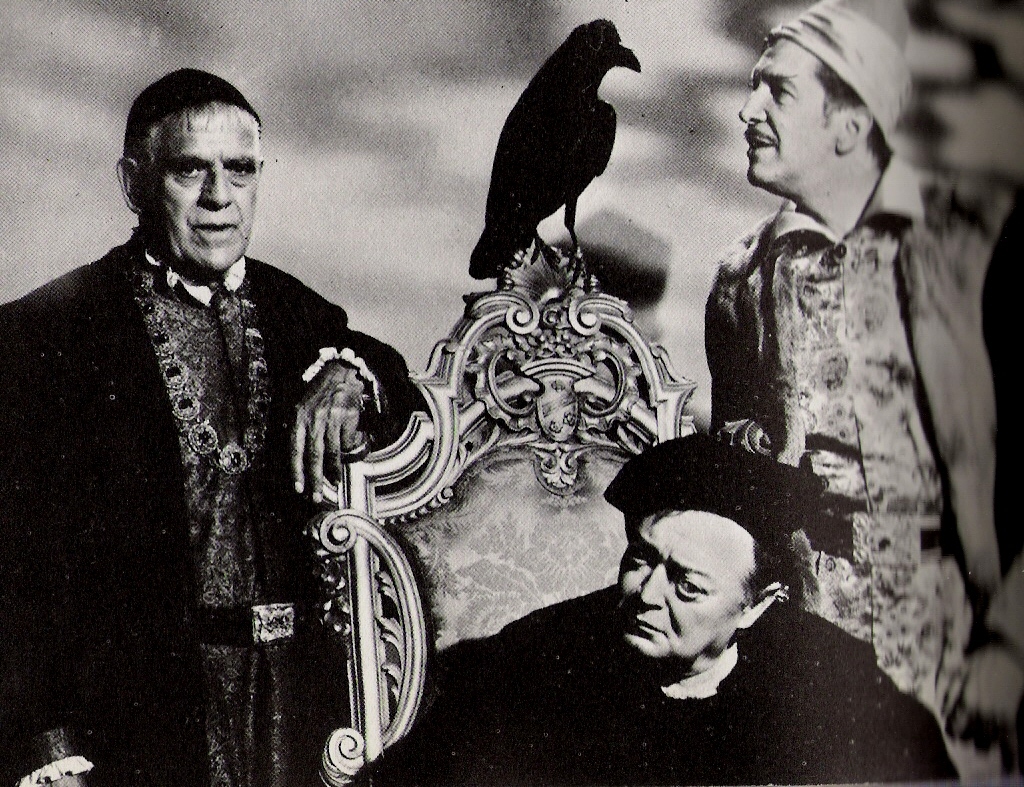
"The Raven" (1963, Roger Corman, AIP) is a somewhat comic adaptation of Poe's famous poem of the same name and should also not be confused with another Karloff film from 1935 of the same name which also starred Bela Lugosi.

In this film a sorcerer named Dr. Erasmus Craven (Vincent Price) is going about his wizardly business and mourning the death of his wife Lenore (Hazel Court), when he is interrupted by a rather blustery talking raven. Using a potion that the raven instructs him on how to make, Erasmus returns the raven to its true form, that of Dr. Bedlo (Peter Lorre), a fellow sorcerer.

Bedlo reveals that he was transformed during a duel with the evil wizard, Dr. Scarabus (Boris Karloff) and also happens to mention seeing Craven's wife's ghost wandering Scarabus' castle. Both wizards set out together, along with Erasmus' beautiful daughter, Estelle (Olive Sturgess), and Bedlo's son, Rexford (a very young Jack Nicholson), to deal with this Scarabus once and for all.

Of course, this advance results in a rather funny and tongue-in-cheek wizard duel between Price and Karloff with a lot of entertaining 60s special effects.

The wardrobe of the cast is also quite amusing: the wizard hats especially!

Whilst it's not really a horror movie, I like this film for several reasons:
  • It stars some of my favourite horror icons
  • It has a sense of humour
  • It's set in a big creepy castle
  • It involves B-movie special effects
Essentially, this is a light hearted romp starring some extremely wonderful people, and Vincent Price reading the poem really gives me the chills! (although it's notable that aside from that and the fact that there is a raven present for some scenes, this film has practically nothing to do with the actual poem).

[Image: AIP]
Hani

Monday, 23 December 2013

The Pit and The Pendulum

"The Pit and The Pendulum" (1961, Roger Corman, American International Pictures) is one of my favourite Vincent Price films and is based on the short story by Edgar Allen Poe.

It's 16th century Spain and a young man, Francis Barnard (John Kerr), has travelled from England to the castle where his recently deceased sister, Elizabeth (Barbara Steele), lived with her nobleman husband, Nicholas Medina (Vincent Price). He is greeted with suspicion by the butler and urged to leave, but upon meeting Nicholas' sister Catherine (Luana Anders) he is permitted entrance to the castle.

He is at first told that Elizabeth died of an unexplained heart complication, however, as the story progresses more details of Elizabeth's sticky end are revealed. It is upon the discovery of Nicholas' father's torture chamber that the final ghastly details are slipped and we begin to find that Nicholas is becoming severely unhinged with guilt and fear. Under the guidance of his physician, Dr. Leon (Antony Carbone), Nicholas exhumes the body of Elizabeth to find that his worst fear is apparently true; she was buried alive!

Believing that he is being haunted by the vengeful spirit of Elizabeth, Nicholas slips into insanity,  rampaging terribly and using his father's torturous devices. However, all may not be as it seems...

A riveting tale and one of my favourite performances from Price as the tortured but twisted Medina. An atmosphere from the sparse, classic surroundings really lends itself to the film and the haunting ending really works.
 
 
[Image: American International Pictures]
Hani

Sunday, 26 May 2013

Frankenstein Created Woman

"Frankenstein Created Woman" (1967, Hammer Film Productions, Warner-Pathé, 20th Century Fox, Optimum Releasing, Terence Fisher) is the fourth Hammer Horror Frankenstein feature and it is one of my favourite Peter Cushing films. I'm watching it today to celebrate what would have been his 100th Birthday. Happy Birthday, Peter Cushing you were an excellent actor and a gentleman!

The film opens to a guillotine and the beheading of a father while his young son, Hans looks on.

Fast forward several years and Hans (Robert Morris) is now a young man working for Dr. Hertz (Thorley Walters) and assistant to Baron Victor Frankenstein (Peter Cushing).

Frankenstein has developed his work of 'giving life' much further than his previous patchwork creations and is now dabbling with the more spiritual theories of the soul. He has found that the soul remains intact after death and can be restored after life. Yep, ol' Frankie's outdone himself with his new bolt-free creations!

After a series of unfortunate events and general mishandling of situations, feisty young Hans is sentenced to the guillotine for a murder he did not commit. Facing the same fate as his father, Hans cannot explain that he has an alibi because he was making love to the local barmaid, the disfigured but kind Christina (Susan Denberg), a love interest he has been barred from pursuing by Christina's father. Plus who would believe a murderer's son over the word of three snobby young toffs with lots of cash?

Christina is too late to save Hans from his fate and, in despair, she commits suicide inadvertently providing Frankenstein with two fresh bodies to experiment on! But, perhaps the Baron's scientific theory is not fully correct...! Could his beautiful new scar-free creation be just as much a monster as his last attempts?!

Cushing delivers a cold and calculating Dr. Frankenstein who is witty, clever and driven. His Dr. Frankenstein character is always the best in my opinion!

Susan Denberg also excels in her role switching from sweet and innocent bar wench to sultry vixen to crazed lady.

A fun little Hammer Horror with a nice alteration to the usual Frankenstein story and some really lovely decapitation scenes filmed in characteristic Hammer fashion; showing little while letting your imagination fill in the gaps with some dripping blood here and there.

If you haven't seen this film yet, I recommend giving it a try from some old school Hammer viewing.

[Image: Hammer Film Productions]
Hani

Friday, 7 September 2012

The Nanny (1965)

"The Nanny" (1965, Seth Holt, Hammer Film Productions) is the last Hammer Horror shot in black and white. The last silverscreen Hammer. It's based on a novel of the same name by Evelyn Piper.

This is one of the best Hammer Horrors that doesn't feature a monster (psychological horror by any other term), because in essence it's terrifying! Also, not one of the characters is likable. And while in modern slasher films this is the norm (7 faceless beautiful people seriously lacking personality go into a... and get killed off one by one by ... in a mask with an 'insert weapon here'), in original horror cinema, most directors and writers usually spent some time building up at least one sympathetic character. In "The Nanny" none of the characters are really very likable, but it works because they're all very real and the idea behind the film is all too possible!

An upper-middle-class couple, Virgie (Wendy Craig) and Bill (James Villiers) Fane are having to come to terms with the fact that their young son Joey (William Dix) is returning from his boarding school/child's prison after serving his sentence for the part he played in the death of his toddler sister, Susy (Angharad Aubrey). Hint, they think he's insane. Joey's a bratish child who enjoys tormenting middle aged women (although when you discover why, can you really blame him?) and his hysterical mother cannot deal with anything, never mind her son's disturbing abruptness and apparent hatred of everyone, especially Nanny (the fantastic Bette Davis).

Bill is a distant father, as was accepted in the day, and a bit of a bully, he spends a lot of time at work. This is why, despite there having been no children in the house, Nanny, has remained to look after Virgie.

Virgie's ailing but independent sister Penelope, or 'Aunt Pen' (Jill Bennett) as she's known, is a jealous woman and has a short temper and an annoyingly direct manner that mirrors Joey's precisely.

In fact, you're pretty much made to feel sorry for Nanny, when seeing the film for the first time. She tries hard to win Joey over, and deal with the distraught Virgie, but you soon see the cracks in her armour as her idea of reality crumbles and the tragic events of the past are revealed. Also, she is trying to kill an innocent little boy, brat though he is, it's hardly the Nanny-like thing to do! What would the neighbours think!?

Joey's little friend from upstairs, Sarah (Sandra Power) is an obnoxious character, but I remember being a young teen, and I'm pretty sure I was the same!

The film starts as a slow burner, but action slowly picks up and the revealing scenes, if you can let yourself fall into the film, are quite shocking and sad.

I recommend giving this film a try, it's an original plot and the simplicity of the horror is cutting.


[Image: Hammer Film Productions]

Hani

Tuesday, 28 August 2012

Witchfinder General

"Witchfinder General" (1968, Tigon British-American International, Michael Reeves) is a British witch trials-centred horror starring the horror master, Vincent Price.

Price plays The Witchfinder, Matthew Hopkins (an actual man in British History, who was responsible for many atrocities in his time, but wasn't sanctioned by the government or church, unlike this tale).

The year is 1645, the time of The English Civil War, and law and order are virtually non-existent. Belief in witches is rife, and the scapegoating of women for everyday ills and unfair treatment is commonplace. Hopkins spends his life travelling the length and breadth of the country 'hunting', torturing and exacting justice on 'witches' with his team of followers.

Vincent Price is terrifying in this film, even by today's standards. Hopkins is insane, determined, evil minded and has the power of 'god' behind him... The church of the day supported this kind of behaviour, so no one was safe.

A lot of screaming goes on in this film. A lot. It's virtually a screamfest. I had to turn it down to avoid annoying my neighbours!

Despite there being pretty much no gore at all, the tense, suspicious feeling this film creates is tangible. There are also some hanging scenes which are disturbing in their simplicity.

Being a later film of this type, they felt the need to bring in some boob shots and a lot of shots of the whoring and activities of the menfolk. And we all know the priest's neice is in for some trouble after her pre-marital sexcapades with her betrothed! Also there's some rape. Thankfully off camera, but rape nonetheless.

Hopkins rolls into town to accuse the Priest of being in league with Satan (and all his little wizards if you watch 'Blackadder'). His neice is distraught and bargains for his safety with her virtue (little does Matthew know she's not actually a virgin...). When her soldier fiancé finds out, he races back to save the day!

As I mentioned, a lot of screaming and hangings (and other real witch finding tortures; pricking with needles, dooking in water, the ladder over fire....). There's little gore, but some very red blood. The story is simple and effective (I have never read the novel, so can't comment on trueness to plot) and as I mentioned, Price is an excellent villain in this piece! Even his own men hate him!

A surprisingly brutal film, with some remarkably true points on witch hunting in Britain in this era, as well as a good yarn. Oh, and no actual witches. This isn't a supernatural film!


[Picture: Tigon British-American International]
 
Hani
 

Monday, 11 June 2012

The Birds

"The Birds" (1963, Alfred Hitchcock, Universal Pictures) is a very suspense-filled nature-bites-back horror film.

Melanie Daniels (Tippi Hedren) is a young woman of leisure from a rich family. She is goaded by a young lawyer, Mitch Brenner (Rod Taylor) in a bird shop and, intrigued, goes out to his home town, Bodega Bay, California, to teach him a lesson. She winds up meeting his mother, Lydia (Jessica Tandy) and little sister Cathy (Veronica Cartwright) and decides to hang around as Mitch and she become close.

She is randomly attacked by a seagull while on her boat back from his house, but dismisses this as an odd happenstance. Later that night, another seagull flies face first into the front door, killing itself, but she also dismisses this.

She rents a room with the local school teacher, Annie Hayworth (Suzanne Pleshette), who also happens to be Mitch's ex, and joins Mitch and his family for dinner.

A series of other bird attacks soon become suspicious, and the town slowly realise that the birds are purposefully attacking them!

Some gorey corpses always interested me in this movie as a child, especially the guy with his eyes pecked out! And the bit with the sparrows and the fireplace is still spooky!

If you have a bird phobia, obviously this film is either not for you, or will give you a good scare, depending on what kind of person you are (for instance zombies give me the grade A creeps, which is why I love watching zombie movies; actually scary!).

Melanie's character is enjoyable as a female protagonist as she doesn't scream mindlessly all the time. She keeps it cool until the end when she finally loses it, and she's actually useful without being written as a man with boobs (see the character of Rayne in the first 'Resident Evil' movie). In fact, the only time I was willing her to scream is the bit in the attic when she does lose her cool; screaming would have been helpful here!

I find this film a little slow to start, but once it begins it keeps up the pace and the slow build up of birds around the houses and school is really, very atmospheric. I also enjoyed the constant, intially unnoticeable, but later very obvious, bird noises throughout the movie. The flocking noises are reminiscent of insects swarming which is very effective.

I like birds, and have a pet parrot called Paulie (yes, honestly that is his name), but I can hands-up admit that when he freaks out and goes for your face it is the scariest thing! I can't imagine what hundreds of angry, panicked birds attacking you would feel like, and I don't think I ever want to know!

The reason for the attacks is never explained and the end of the movie is open with no real conclusion. But rather than feeling cheated, this adds to the charm of the film. A real classic.

[Picture: Universal Pictures]

Hani 


Thursday, 31 May 2012

The Brain That Wouldn't Die

"The Brain That Wouldn't Die" aka "The Head That Wouldn't Die" (1962, Joseph Green, American International Pictures) is a 'fabulous' little black and white horror/sci-fi B-move.

According to the box it was actually made in 1959, but for some reason wasn't released until 1962. Also, it seems to be available on the public domain, and I got it in the Pound Shop for, wait for it, 50p (it was a buy one get one free). So you know it's gonna be quality stuff!

Dr. Bill Cortner (Jason Evers) has become obsessed with his experiements in making body parts remain alive after dismemberment or death and reattaching them successfully to living tissue.

Unfortunately, during an odd car accident, Bill's fiancée, Jan Compton (Virginia Leith) is randomly decapitated. Naturally, Bill's reaction is to save the head, run to his laboratory and reanimate it before it's too late!!! I'd like to think this was the natural gut reaction of every man....not!

He keeps Jan's dismembered head alive in his laboratory while he considers murder in order to obtain a body for his soon-to-be-wife.

Jan, naturally, is not very chuffed with the situation. She's stuck in a tray of liquid as a head for FFS! She probably had an itchy nose, too!

She finds that she is able to communicate telepathically (I believe this has something to do with the life-preserving liquid) and begins to 'talk' to the creature in the locked laboratory cupboard (a failed experiment of Bill's). She hopes to kill Bill (heh, see what I did there?) and then end her own miserable existence.

The hideous creature does as Jan wishes and disposes of the doctor, saving the young woman Bill had planned on butchering. Unfortunately, it leaves the lab without killing Jan, who for all her complaining, doesn't seem too fussed about this. Maybe she figured the liquid would evaporate and she'd eventually die...

A good ol' yarn with some impressive special effects for the day, but not a very expensive movie to make and very old fashioned! The script is a little dull in places and the story makes little sense. But it's a B-movie! What do you want?!

I think if they remade this movie instead of potentially destroying the 'Evil Dead' saga, I would be very pleased. They could really update this film successfully! Unfortunately, this is not the case.

But poor old Jan in the Pan!

[Picture: American International Pictures]

Hani 


Tuesday, 22 May 2012

The Haunting (1963)

"The Haunting" (1963, Robert Wise, Metro-Goldwyn-Mayer) is a silverscreen haunted house story, based on the novel "The Haunting of Hill House".

Four ghost hunters spend the night in Hill House in order to prove whether or not ghosts truly walk the halls. The film is very creaky and I find the mental narration from Nell (Julie Harris); the paranoid, jittery, old-maid character to be less tense and more tiresome. She is meant to be a woman who spent her life looking after her mother and has no life or possessions of her own, but she comes across as an annoying and selfish simpleton.

The other characters are:

Theo (Claire Bloom) the glamourous and confident woman.

Luke (Russ Tamblyn) the next person to inherit Hill House and a disbeliever of the supernatural.

Dr. John Markway (Richard Johnson) a ghost enthusiast and academic.

Before long, the spooky stuff begins to happen; writing on the walls, noises, becoming lost, strange winds, doors opening and closing by themselves, faces appearing on walls and doors seeming to bend inwards at our characters.
The main focus of the supernatural events appears to be Nell who is both terrified and flattered with the attention (having never had so much of it before). She begins to feel a connection to the house, but there's been a sad history of deaths connected to the building and the others are reluctant to give her her way.

The set up of the movie is elegantly portrayed, the story of the house being built, the tradgedies which befell it and the young girl who grew old and bitter in it are well played out.

The special effects for this movie are good for the time! I especially like the door which the ghosts push against.

This is one of the few black and white movies (which weren't monster movies or mad scientist movies) where there really are ghosts, although you don't see much naturally.

Only a movie for real enthusiasts or nostalgics as it's quite long-winded and boring at times.

[Picture: Metro-Goldwyn-Mayer]

Hani